
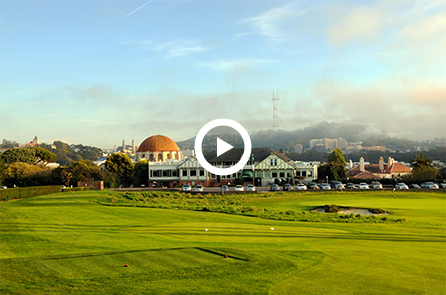
About Presidio Golf Course

Located within a national park, San Francisco’s Presidio Golf Course is renowned for its spectacular forest setting, as well as its challenging play. Once restricted to military officers and private club members, today the 18-hole course is open to the public. Presidio G.C. offers a full service restaurant, a driving range and practice facility, and an award winning golf shop that offers the latest in golf equipment and apparel. Presidio Golf Course is a contributing feature of the Presidio’s National Historic Landmark status. It is also notable for its environmentally sensitive management practices.

The Course

God shaped this land to be a golf course. I simply followed nature.
– John Lawson, designer of the first course

Presidio Golf Course is built on a variety of terrains. Holes are constructed over a base of adobe clay, rock, sand, or a combination of all three. The early Presidio Golf Course was short, but challenging. Players were often shocked by the level of difficulty and natural obstacles. Lawson Little, stamped by Golf Magazine as the greatest match player in the game’s history, said, “I have played the best courses here and abroad, but none more enjoyable than my home course of Presidio. I learned how to strike the ball from every conceivable lie. Presidio demands accuracy, but being a long hitter, I also had to learn how to hook or fade around trees. I had the reputation of being a strong heavy-weather golfer; well, Presidio has powerful wind, rain, fog, sudden gusts, and sometimes all four on any given round.”

Environmental Sensitivity

Presidio Golf Course has been recognized as a leader in environmentally sensitive golf course management, winning the 2001 “Environmental Leader in Golf Award”. Since 2000, the course has reduced overall pesticide use by approximately 50%, and currently uses approximately 75% less pesticide than private courses in San Francisco. The course also received certification from Audubon International as a partner in the Audubon Cooperative Sanctuary Program in 2003.

The course uses an innovative form of pest management and turf management called compost tea. “Compost tea” is a solution made by soaking compost in water to extract and increase the beneficial organisms present in the compost. It is then sprayed over the greens. The result is turf with longer root growth and less plant disease fungi.

The Brazzers Podcast Episode 6 -2024- Brazzerse... -

In the modern era, popular entertainment is not merely a passive distraction; it is a dominant force that shapes language, fashion, social values, and even geopolitical perception. At the heart of this cultural machinery lie the entertainment studios and their productions. From the silent film lots of early Hollywood to the streaming juggernauts of the 21st century, these studios serve as the primary architects of our collective imagination. By examining their evolution, business models, and cultural impact, it becomes clear that popular entertainment studios are far more than content providers—they are the mythmakers of the modern world.

The history of the entertainment studio is a story of industrialization. In the early 20th century, the "Big Five" studios—MGM, Paramount, Warner Bros., RKO, and 20th Century Fox—perfected the , a vertically integrated model where they controlled production, distribution, and exhibition. This era gave birth to the "star system" and genre filmmaking (musicals, westerns, film noir), creating a dream factory that churned out escapism during the Great Depression and propaganda during World War II. The subsequent collapse of this system due to antitrust laws in the 1940s-50s did not kill the studio; it forced evolution. The rise of television saw studios like Disney pivot to family-friendly weekly series, while others licensed their libraries. This adaptability is the hallmark of a successful studio: the ability to survive technological disruption, from cable television and home video to digital streaming. The Brazzers Podcast Episode 6 -2024- Brazzerse...

In conclusion, popular entertainment studios and their productions are the primary storytellers of our age. They have evolved from industrial lots to global IP empires, navigating technological change and cultural shifts with relentless pragmatism. While their focus on franchises and global markets risks artistic sterility, their ability to create shared, emotional experiences remains unparalleled. The studio is a mirror and a molder: it reflects our current anxieties and aspirations while actively shaping the dreams of the next generation. To understand the modern world, one must understand the studios—because, more and more, we live in the worlds they build. In the modern era, popular entertainment is not

Today, the landscape is dominated by a new "Big Few": Disney, Warner Bros. Discovery, Netflix, and Sony. These entities are no longer just film studios; they are . Disney’s acquisition of Pixar, Marvel, Lucasfilm, and 20th Century Fox exemplifies a strategy of intellectual property (IP) dominance. A single production, such as Avengers: Endgame , is not a standalone film but a culmination of over a decade of interconnected storytelling across movies, Disney+ series, theme park attractions, and merchandise. Similarly, Netflix revolutionized the model by moving from a distributor of others' content to a creator of proprietary "originals," using data analytics to greenlight productions like Stranger Things or Squid Game that cater to niche global audiences. The production has become the primary asset, more valuable than the physical studio lot itself. By examining their evolution, business models, and cultural

The cultural impact of these productions is profound and often double-edged. On one hand, blockbuster productions like Marvel’s Black Panther or Pixar’s Coco have provided long-overdue representation, validating identities and histories for millions of viewers. The global reach of a studio like Netflix has democratized access to international content, sparking worldwide phenomena for South Korean ( Squid Game ), Spanish ( Money Heist ), and French ( Lupin ) productions. On the other hand, the studio system’s relentless focus on proven IP has led to what critics call "franchise fatigue"—a landscape dominated by sequels, prequels, and reboots. The pressure to produce "safe" content for a global audience can lead to a homogenization of art, where risk-taking auteur cinema is marginalized in favor of algorithm-friendly, four-quadrant blockbusters.

Furthermore, the economic reality of modern studios raises significant ethical questions. The "streaming wars" have led to an explosion of content, but also to the "crunch" culture of visual effects artists, the residuals battle fought by the WGA and SAG-AFTRA strikes of 2023, and the sudden "shelving" of completed productions for tax write-offs. The studio as a benevolent dream factory has been replaced by the studio as a ruthless content optimization engine. Yet, even within this system, productions like Everything Everywhere All at Once (distributed by A24, a new-model indie studio) or Barbie (Warner Bros.) demonstrate that studio-backed films can still be innovative, self-aware, and artistically daring.

Presidio Golf Course, A National Historic Landmark

A National Historic Landmark Since 1962

Originally designed by Robert Wood Johnstone, the golf course was expanded in 1910 by Johnstone in collaboration with Wiliam McEwan, and redesigned and lengthened in 1921 by the British firm of Fowler & Simpson.

LEARN MORE

In the modern era, popular entertainment is not merely a passive distraction; it is a dominant force that shapes language, fashion, social values, and even geopolitical perception. At the heart of this cultural machinery lie the entertainment studios and their productions. From the silent film lots of early Hollywood to the streaming juggernauts of the 21st century, these studios serve as the primary architects of our collective imagination. By examining their evolution, business models, and cultural impact, it becomes clear that popular entertainment studios are far more than content providers—they are the mythmakers of the modern world.

The history of the entertainment studio is a story of industrialization. In the early 20th century, the "Big Five" studios—MGM, Paramount, Warner Bros., RKO, and 20th Century Fox—perfected the , a vertically integrated model where they controlled production, distribution, and exhibition. This era gave birth to the "star system" and genre filmmaking (musicals, westerns, film noir), creating a dream factory that churned out escapism during the Great Depression and propaganda during World War II. The subsequent collapse of this system due to antitrust laws in the 1940s-50s did not kill the studio; it forced evolution. The rise of television saw studios like Disney pivot to family-friendly weekly series, while others licensed their libraries. This adaptability is the hallmark of a successful studio: the ability to survive technological disruption, from cable television and home video to digital streaming.

In conclusion, popular entertainment studios and their productions are the primary storytellers of our age. They have evolved from industrial lots to global IP empires, navigating technological change and cultural shifts with relentless pragmatism. While their focus on franchises and global markets risks artistic sterility, their ability to create shared, emotional experiences remains unparalleled. The studio is a mirror and a molder: it reflects our current anxieties and aspirations while actively shaping the dreams of the next generation. To understand the modern world, one must understand the studios—because, more and more, we live in the worlds they build.

Today, the landscape is dominated by a new "Big Few": Disney, Warner Bros. Discovery, Netflix, and Sony. These entities are no longer just film studios; they are . Disney’s acquisition of Pixar, Marvel, Lucasfilm, and 20th Century Fox exemplifies a strategy of intellectual property (IP) dominance. A single production, such as Avengers: Endgame , is not a standalone film but a culmination of over a decade of interconnected storytelling across movies, Disney+ series, theme park attractions, and merchandise. Similarly, Netflix revolutionized the model by moving from a distributor of others' content to a creator of proprietary "originals," using data analytics to greenlight productions like Stranger Things or Squid Game that cater to niche global audiences. The production has become the primary asset, more valuable than the physical studio lot itself.

The cultural impact of these productions is profound and often double-edged. On one hand, blockbuster productions like Marvel’s Black Panther or Pixar’s Coco have provided long-overdue representation, validating identities and histories for millions of viewers. The global reach of a studio like Netflix has democratized access to international content, sparking worldwide phenomena for South Korean ( Squid Game ), Spanish ( Money Heist ), and French ( Lupin ) productions. On the other hand, the studio system’s relentless focus on proven IP has led to what critics call "franchise fatigue"—a landscape dominated by sequels, prequels, and reboots. The pressure to produce "safe" content for a global audience can lead to a homogenization of art, where risk-taking auteur cinema is marginalized in favor of algorithm-friendly, four-quadrant blockbusters.

Furthermore, the economic reality of modern studios raises significant ethical questions. The "streaming wars" have led to an explosion of content, but also to the "crunch" culture of visual effects artists, the residuals battle fought by the WGA and SAG-AFTRA strikes of 2023, and the sudden "shelving" of completed productions for tax write-offs. The studio as a benevolent dream factory has been replaced by the studio as a ruthless content optimization engine. Yet, even within this system, productions like Everything Everywhere All at Once (distributed by A24, a new-model indie studio) or Barbie (Warner Bros.) demonstrate that studio-backed films can still be innovative, self-aware, and artistically daring.

The Brazzers Podcast Episode 6 -2024- Brazzerse...
Processing...
Thank you! Your subscription has been confirmed. You'll hear from us soon.
EMAIL SPECIALS
Join our email specials list to get our Weekly Update newsletter and occasional other specials and event announcements!
ErrorHere